High-converting landing page: a step-by-step guide to building one
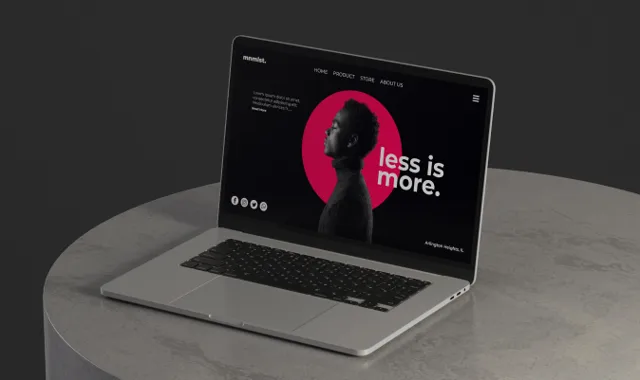
Are you looking for a landing page that converts?
That's probably what every digital entrepreneur is after. After all, the landing page (LP), also called a lead capture page, is part of the strategy of almost every online business. And when it isn't well planned, it becomes a bottleneck in the buyer's journey that can cause huge losses.
In this article, Cademí's team of experts will make sure you end up with a high-converting landing page. To do that, we'll explain:
- What a landing page is
- How to create high-converting landing pages
- What the sections of a landing page are
- Section structure for a sales LP
- Section structure for a lead generation LP
- Three examples of landing pages that convert
- Other important elements in building a landing page
- Where to create a landing page
What is a landing page
To start, it's important to understand the concept behind an LP.
In short, a landing page is a page created to convert visitors into leads or customers. So, unlike a website with multiple pages and lots of information, an LP is a single page fully focused on one specific action. That could be, for example, signing up to access exclusive content or buying a product.
No distractions or links that take people somewhere else. All the content and design are built to drive the desired conversion.
It's the combination of all these things that makes the landing page such a powerful tool for maximizing conversions in digital marketing campaigns. As long as it's built strategically for that.
So, how do you create high-converting landing pages?
The truth is that there's no set formula for what a landing page should look like. The answer to that question lies in your persona and their interests. That's why the tip is to start by clearly defining your goals for this landing page and also your leads' goals.
Do you want to capture contacts or convert sales?
The answer to that question will directly influence the design, structure, and content of the page. After all, if you want to capture contacts, the sign-up form needs to be right at the top of the page. But if the goal of the page is to sell, you need to provide more information.
What are the sections of a landing page
Traditionally, a landing page is said to be divided into sections, or folds.
You've probably heard the term "above the fold" and weren't sure what it meant. But it's simple: the fold of a landing page is the part you can see without scrolling.
In an LP's structure, each section has a specific goal. But in general, the first section of an LP is what visitors see as soon as they land, so it's extremely important. It's what determines whether the user stays on the page (or not).
The sections that follow vary depending on the goal of your landing page.
Section structure for a sales LP
First section: main call to action
Since this is your potential customer's first contact with your online business, it's important to include:
- A strong headline that makes your offer and its benefits clear;
- A subheadline that briefly expands on that information;
- Main call to action (CTA);
Second section: value proposition and benefits
Now that you have your visitor's attention, the goal is to provide more details and build interest. So use this moment to show why the offer is valuable and how it's the solution the visitor needs.
Make sure to include:
- Details of the value proposition;
- Key benefits, ideally as a list to make them easy to read;
Third section: social proof
This is the time to strengthen your authority and the trust visitors have in you. To do that, work on social proof and on overcoming objections with:
- Customer testimonials;
- Customer case studies;
- A list of well-known customers (with logos or photos);
Fourth section: details
What do you want to reinforce in your messaging? Use this moment to give more details about your strongest points, the ones that can't go unnoticed. To do that, include:
- A detailed explanation of what's being offered;
- Frequently asked questions;
Fifth section: final call to action
We're reaching the end of your LP, so this is the time to reinforce your CTA. Take the opportunity to create a sense of urgency. These can help:
- A new summary of the benefits;
- A CTA button;
- A headline that creates a sense of urgency;
- A link to your privacy or security policy;
Section structure for a lead generation LP
For lead generation, the structure changes in one way: what matters most to you is that the visitor fills out the form with the information you want.
So the CTA points to the form, and it should already be in the first section.
Here, the visitor usually arrives ready to convert. They want access to the e-book or to sign up for the course. So don't let them give up. The content structure across the sections can stay the same. But always remember that the goal is the sign-up. That's why the form should appear (usually in the first and last sections).
Three examples of landing pages that convert
#1 Netflix
To start, our experts picked the Netflix landing page to show that this kind of page isn't exclusive to digital product creators. Companies of all sizes rely on lead capture and sales pages for their business.
In Netflix's case, the goal is the sale. That's why the sign-up form is right in the first section. And it only asks for an email address.
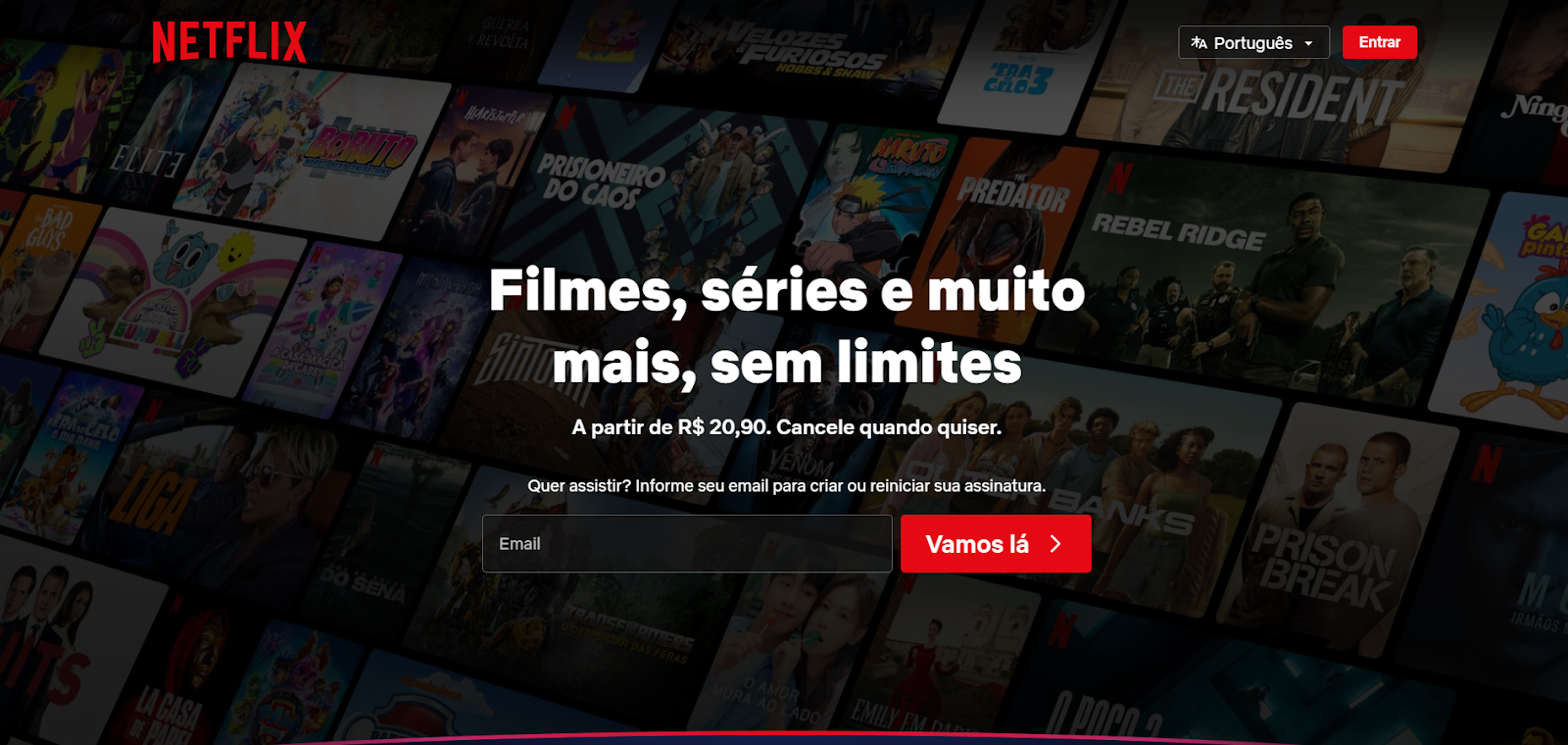
Once the email is entered, that lead is already in the database. Next come four simple steps to set up the account and start streaming. Splitting it up even helps remove the impression that it's a long process, since each step has only a few questions to answer.
#2 Gabi Cervantes
In case you don't know her, Gabi Cervantes is an authority in sales and digital strategy in general. Her business has more than one landing page, one for each product.
In this case, we analyzed the one for the “Imersão O Fim do Perpétuo” workshop.
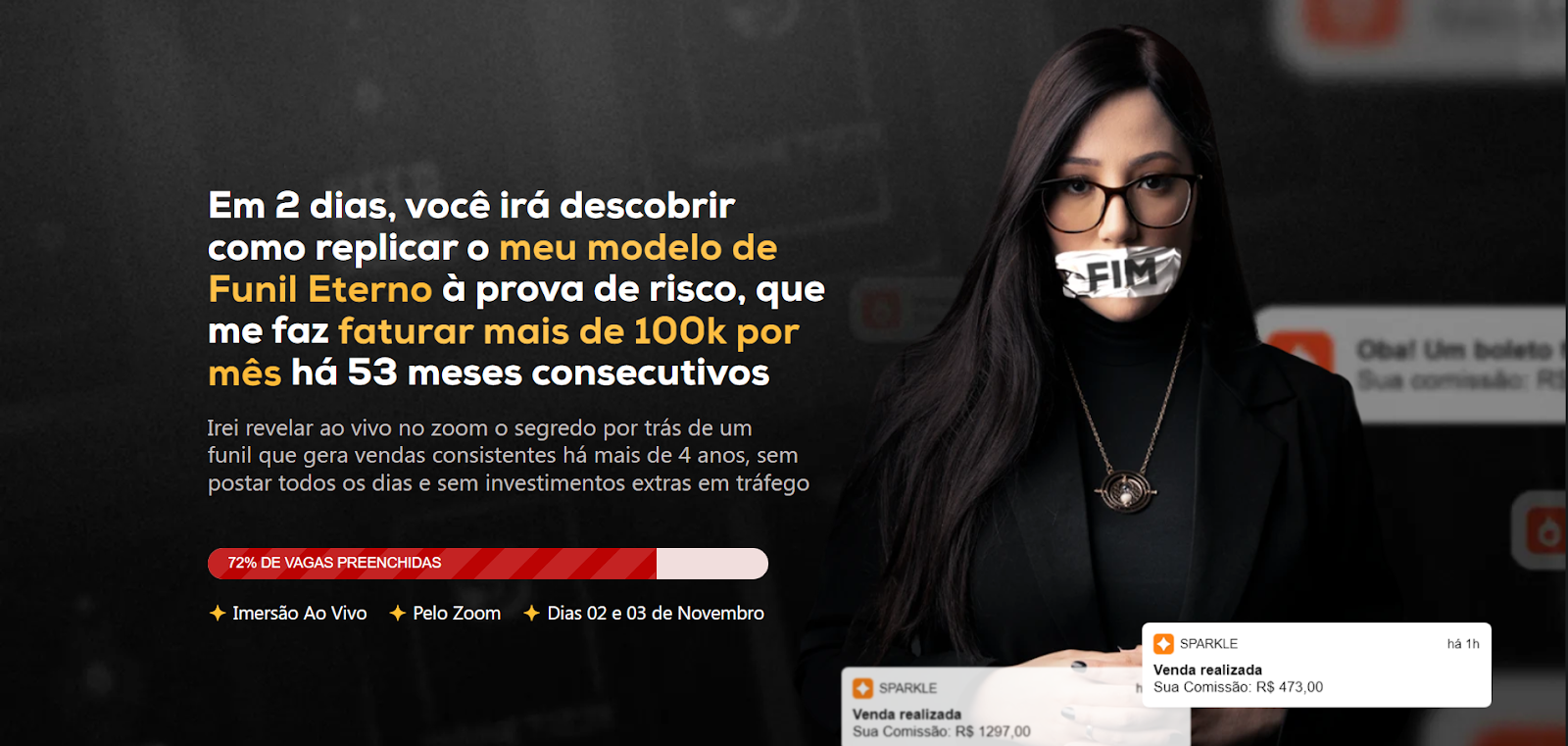
In the first section, she uses scarcity by showing a bar with the number of spots already filled, right after presenting the solution the content offers. Then the next sections include:
- Data that shows her authority on the subject;
- A description of the content that already shows the benefits through the persona's pain points;
- A description of the ideal audience and, at the same time, a challenge to those who choose not to join;
- Details on how the immersion program will work;
She also restates the offer, brings back scarcity, and adds an introduction of herself. It's a structure that nudges toward the purchase at every moment and was probably built after a lot of research on the persona and on what does or doesn't work for them.
#3 Cademí: O Grande Colapso
Finally, Cademí itself has a number of landing pages that convert.
We chose the one created for O Grande Colapso, an event hosted by our CEO and CMO, Matheus Benatti and Rodrigo Volponi. Since it's an event, the goal is to get visitors to sign up. That's why the form is right in the first section and asks only for the necessary information.
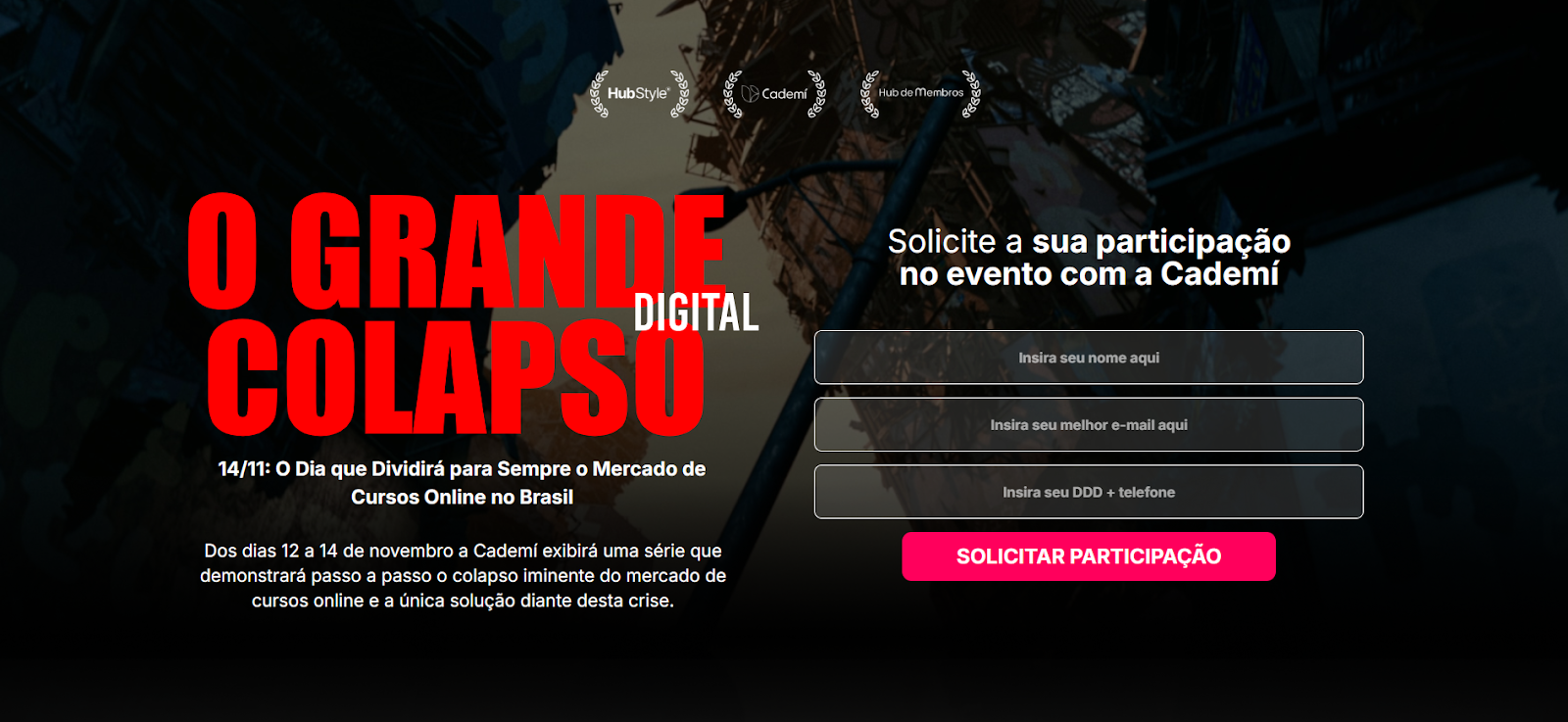
Next, we present:
- What will be taught at the event;
- The ideal audience;
- An introduction of the experts leading the event, to build even more authority;
Other important elements in building a landing page
Beyond all this, it's important to remember that an LP is a page meant to drive a single action. So go for a simple, clean design with a clear visual hierarchy. No distractions.
A clean design will also ensure your page loads fast.
According to experts, the ideal load time for a high-converting landing page is under two seconds. At that speed, fewer people leave and, as a result, the conversion rate goes up.
Also remember to make your page mobile first. Most users access the internet on mobile devices, so navigation needs to be designed for phones. Make sure all elements, especially the CTA and forms, are accessible and work on any screen.
Where to create a landing page
Now that you know everything you need to have a landing page that converts, you're probably wondering where to build it.
There are countless platforms on the market for this. Just to name a few, some of the easiest to use are:
- Wix;
- WordPress with Elementor;
- Hostinger;
- Unbounce;
- RD Station;
Which one to use is a personal choice and depends on your skill level, how mature your business is, and your budget. Our recommendation is to research the pros and cons before you choose.
And if you need help taking your online business to the next level, remember you can count on Cademí's team of experts. Schedule a strategy call by clicking here and find out how we can help.