Online Course Profit Margin: How to Grow Yours in 2027
A fixed fee, tax on your ads, the book invoice and 2027's CBS: the front-end math, bite by bite, until R$ 2 is left per sale. And the value ladder that pays the bill.

12 min read

You made 500 sales of your front-end offer this month. Next year, those sales will put in your pocket only what 82 sales did in 2025.
That means you'll need to sell 6.1 times more to take home the same money starting in 2027.
This isn't a figure of speech. It's the online course profit margin worked out with pencil and paper, for a low-ticket course that serves as your front-end offer.
Nobody took your profit all at once: it was four small bites, each one with a good excuse, and together they ate the product that used to pay for your operation.
You don't have to take my word for it. Do the math with me, one bite at a time.
The math you're not doing
Search for the profit margin of a digital product and the answer comes back close to 80%, like in this example, without ad spend and without the per-sale fee. Let's put both into the math.
Take a R$ 37 front-end offer and R$ 9,250 a month on Meta (paid traffic), with a ROAS of 2.0, which sits in the middle of the typical range for low-ticket sellers (1.8 to 2.5). The business is an example, but the fees and taxes are today's, with sources.
The example business | |
|---|---|
Front-end offer | R$ 37 |
Sales per month | 500 |
Revenue per month | R$ 18,500 |
Meta ad spend to make those sales | R$ 9,250 |
In 2025, that front-end offer left you about R$ 6.2k a month, after taxes, and that's what paid for the operation.
Now look at what 2026 did to it.
Bite 1: the platform's per-sale fee and the "free" member area
On September 21, 2026, one of the biggest digital product platforms raised its fixed fee per approved sale from R$ 1.00 to R$ 2.49 and, in October, less than 30 days later, R$ 2.49 had become the fixed fee at five of the six main platforms.
It looks like pocket change. And on a R$ 500 product it really is, but on a R$ 37 front-end offer it isn't, because a fixed fee bites hardest on the cheapest product, which is yours. From each R$ 37 sale, R$ 30.85 is left after the platform, and that's before a single real goes to ads.

And do you know what the fixed fee is for? To pay for the member area. And now, with the video player bundled into it, that's out in the open: you pay for the member area on every sale.
And some platforms still have the nerve to say the member area is free. 😂
What the platform charges per month | Math | Amount |
|---|---|---|
Fixed fee: the "free" member area | R$ 2.49 × 500 | R$ 1,245.00 |
Fee on the sale | 9.9% × R$ 18,500 | R$ 1,831.50 |
Getting the balance in 14 days instead of waiting 30 | 2.19% on the 90% that can be advanced | R$ 304.00 |
Total | R$ 3,380.50 |
That's 18.3% of everything you billed, or R$ 40,566 a year, and R$ 14,940 of that is the "free" member area.
And installments? The student pays 3.49% interest a month, and the interest stays with the platform. Getting paid as the student pays is a perk for the platform's favorites, and for everyone else the installment sale comes in advanced, with the advance fee coming out of your pocket.
Your student pays interest. And so do you.
Hold on to that number: R$ 3,380.50. That's what the platform of the "hot market" (the Brazilian launch market) costs you every month. I'll come back to it.
Bite 2: the Meta Ads tax that landed on you
The auction didn't change. Your creative didn't change. And the ad got more expensive.
Since January 1, 2026, Meta has been passing on to advertisers billed in Brazil the PIS/Cofins (federal taxes on revenue, 9.25%) and the ISS (the municipal service tax, 2.9%) that it used to absorb itself, which adds about 12.15% to the bill.
To run R$ 1,000 in ads | 2025 | 2026 |
|---|---|---|
By card (postpaid), you pay | R$ 1,000.00 | R$ 1,138.30 |
By Pix or boleto (prepaid), out of R$ 1,000 this turns into ads | R$ 1,000.00 | R$ 878.50 |
The same R$ 9,250 in ad spend now costs R$ 10,529.28: R$ 1,279.28 more for the same ad. And since Ads Manager shows the amount before tax, the ROAS on the dashboard looks gorgeous, but the bank statement doesn't.
So far, that's what others charge. Now comes what you pay.
Bite 3: the book invoice

I know, and you know too, that you invoice your course as a book (when you invoice at all, right... 👀).
And guess what: they know it too.
Brazil's Constitution makes books immune from tax (art. 150, VI, "d"), the STF (Brazil's Supreme Court) extended that to digital books, and so the course becomes an "e-book with bonuses" on the invoice and the tax plummets.
With 500 sales a month, you're under Lucro Presumido (Brazil's presumed-profit tax regime), where a digital book invoice comes out between 2.28% (with the zero PIS/Cofins rate for books) and close to 6% (without it, since the Receita Federal, Brazil's federal tax authority, denies it to an ordinary e-book). I'll go with the middle, 4%, which comes to R$ 740 a month.
Cheap, right?
Now the part nobody puts on the slide: an online course is not a book. For the tax authorities, a course is a service, with ISS of 2% to 5%, and changing the name on the invoice doesn't change what you sell.
In 2026, that still slips by in the dark.
In 2027, the lights come on.
Bite 4: 2027's CBS and the tax on online course sales
In 2026, CBS (Brazil's new federal consumption tax) and IBS (the new state and municipal consumption tax) ran as a test, but in 2027 PIS and Cofins go away and CBS is charged for real: on October 28, the TCU (Brazil's federal audit court) approved a reference rate of 11.3%.
And yes, books are still immune. What ends is the blind eye: every invoice will carry the CBS and IBS of each transaction, the platform becomes jointly liable with anyone who doesn't invoice the right amount, and split payment begins, with the bank separating the tax based on the invoice before the money reaches you. Good luck calling a course a book in that scenario.
For 2027, I do the math the honest way: the course as a service, under Lucro Presumido, without the credits your accountant may be able to recover.
Tax on the course as a service in 2027 (example, Lucro Presumido) | Rate on revenue |
|---|---|
IRPJ, corporate income tax (15% on the 32% presumed profit) | 4.80% |
CSLL, social contribution on net profit (9% on the 32% presumed profit) | 2.88% |
CBS + IBS (TCU reference for 2027) | 11.30% |
ISS (minimum; ISS only leaves the scene from 2029 on) | 2.00% |
Total | 20.98% |
That's a fifth of your revenue: R$ 3,881.30 a month, in taxes alone. And on the Meta bill I keep today's pass-through.
The online course profit margin, from 2025 to 2027
Now put it all together, with the same front-end offer and the same 500 sales:
Per month | 2025 | 2026 | 2027 (course as a service, example) |
|---|---|---|---|
Revenue | R$ 18,500.00 | R$ 18,500.00 | R$ 18,500.00 |
Meta ad spend | R$ 9,250.00 | R$ 10,529.28 | R$ 10,529.28 |
Platform (no advances) | R$ 2,331.50 | R$ 3,076.50 | R$ 3,076.50 |
Your taxes | R$ 740.00 (4%, book invoice) | R$ 740.00 (4%, book invoice) | R$ 3,881.30 (20.98%) |
Left over | R$ 6,178.50 | R$ 4,154.22 | R$ 1,012.92 |
Margin | 33.4% | 22.5% | 5.5% |
In 2026, a third of what was left went away, and in 2027 84% goes: from each R$ 37, R$ 2.03 is left, before you pay your team and yourself.
And if ROAS drops from 2.0 to 1.8, still within the typical range, the front-end offer loses money, and all it takes is one bad week of creatives.
That front-end offer used to pay for the operation. Now it pays the toll.
You end up living on bets. And then comes the temptation to go back to 2024 and fill your calendar with one-on-one mentorship just to close the month.
That's not the way.
The people ahead of the game have already left this math behind
I see it in several mastermind groups: those who are advanced in this game have already set up their operation outside Brazil. Paraguay? The US with an LLC? Dubai? Pick your destination.
And then it's a different story.
Take Dubai. It has a cost, yes, because a free zone license starts at AED 12,500 a year. Doing the math with the same front-end offer, the same 500 sales and the dirham at R$ 1.46:
Per month | Operation in Brazil (2027) | Operation in Dubai |
|---|---|---|
Revenue | R$ 18,500.00 | R$ 18,500.00 |
Meta ad spend | R$ 10,529.28 (with the 12.15% pass-through) | R$ 9,250.00 (Meta Ireland, no pass-through) |
Platform fee | R$ 3,076.50 (9.9% + R$ 2.49) | R$ 1,636.50 (Stripe: 4.9% + AED 1) |
Advance | mandatory on installment sales; R$ 304 to get the balance in 14 days (not in the total) | optional: the payout lands in 5 business days |
Installment interest (3.49% a month) | paid by the student, kept by the platform | none: Stripe charges up front |
Taxes | R$ 3,881.30 (Lucro Presumido + CBS, 20.98%) | R$ 0.00 (up to AED 3 million in revenue) |
Free zone license | none | R$ 1,520.83 (AED 12,500 a year) |
Left over | R$ 1,012.92 | R$ 6,092.67 |
Margin | 5.5% | 32.9% |
It's the same business, with six times more left over and the 2025 margin back.
Now notice: it wasn't Dubai, it was the student not living inside the platform. You can only switch platforms and keep selling to the same student when the student and their access live in a member area that doesn't belong to the platform. If it's the platform's, you don't leave it: you just pay.
And there's one line that not even Dubai changes: the first sale pays for the entire ad. If your profit depends on it alone, it depends on what you don't control: the platform's fee, Meta's tax, the CBS, your Tuesday ROAS.
The problem isn't your product, it's where your profit lives. That's why the question for 2027 is "what happens after someone buys my front-end offer."
An external member area: control over your margin comes back to you
I'm not talking about the platform's "freebie" one, which you've already seen what it costs, but about one that's independent of it.
You choose (and switch) the platform
When the student lives inside the platform, switching means migrating: lost students, broken access, support on fire. That's why so many people swallow the price hike. And the platform knows it.
With an external member area, you sell through several platforms at the same time, all of them granting access in the same place. One got more expensive? Switch, without migrating anyone. See how to choose the platform and why the "free" member area ends up expensive.
The delivery cost stays fixed
The per-sale fee grows along with you, but in an external member area you pay for the platform, not per student or per sale: the hundredth sale and the thousandth cost the same. You can even put your lead magnet leads in there without paying more.
The member area starts selling
It's not just where the student watches lessons, it's also where they discover the next product: the value ladder.
The value ladder: the low-ticket offer was never meant to make a profit
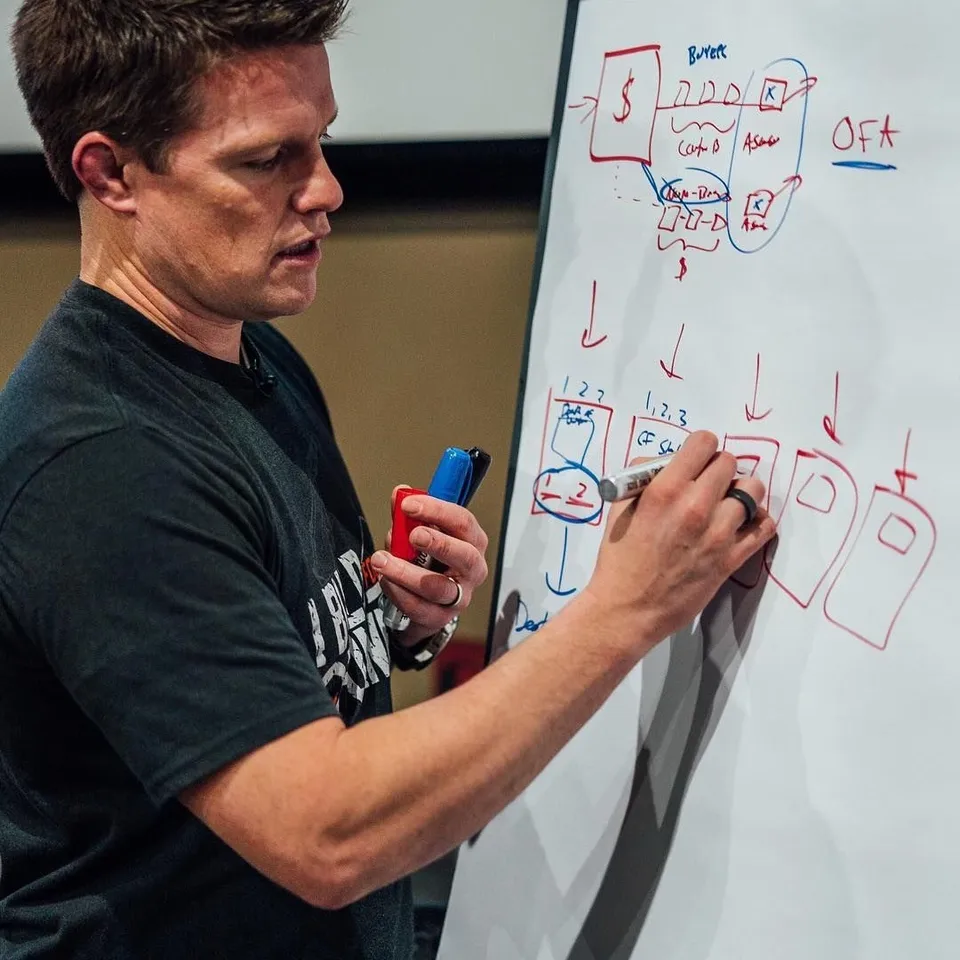
A value ladder is the sequence of offers to the same customer, each step solving a bigger problem and costing more. The person who popularized the concept was Russell Brunson, in the book DotCom Secrets.
Here on the blog we've always called it a product ladder, which is the same idea under another name: on the ladder, the customer climbs.
The front-end offer, your low-ticket product, creates the buyer, not the profit, so anyone who depended on its profit was standing on a step, not on a ladder. And the ladder comes out of the method you already have.
A front-end offer solves a single problem, not the whole method, and that way every problem in your method becomes a way in.
Use the calendar. A cooking course, for example, has an offer at Easter, on Mother's Day and at Christmas, and each date is a niche front-end offer that leads the student to your back-end offer.
Whoever is in the back-end offer wants a shortcut, and the shortcut is group mentorship. Whoever is in the group wants exclusivity, an hour with just you, which is one-on-one mentorship.
Step | What the student wants | The offer | Access to you |
|---|---|---|---|
Front-end offer | To solve one specific problem, now | A short course, often tied to a date | Your content |
Back-end offer | The complete path | Your whole method | Your methodology |
Group mentorship | A shortcut and contact | Group sessions | You, along with other students |
One-on-one mentorship | Exclusivity | An hour with just you | You, focused only on them |
The methodology is the same from the first step to the last. What changes is the access the student has to you.
Order bumps and upsells at checkout already raise the ticket on the first purchase. After that, measure how many climb a step and how long it takes, which is what LTV shows.
But a ladder nobody sees is a wall. That's where almost everyone gets stuck, and that's where the member area solves it.
Where the ladder happens: inside the member area
After the purchase, your student isn't on your Instagram, they're inside the member area, logged in, with their full attention on you.
In a member area built to sell:
- the storefront shows all your products, including the ones the student doesn't have yet, with a lock;
- banners inside the platform lead straight to checkout or to the next product's page;
- the same content becomes several offers (subscription, lifetime, bundle with mentorship).
It's the member area turning into a product ladder that sells on its own. One expert made R$ 180,000 selling to their existing students in the first two months after moving them to an external member area, without investing in new leads (the story). It's selling to people who are already customers, every day.
The ladder pays the bill
Back to the R$ 37 front-end offer, with your 500 buyers a month.
Now they come into a member area where they can see the next step. With example numbers:
- 8% buy the R$ 497 back-end offer: 40 sales;
- 1% buy the R$ 2,000 group mentorship: 5 sales.
These sales don't pay for ads, because the customer is already inside.
Per month | Sales | Revenue | Left over, after fees and taxes |
|---|---|---|---|
Back-end offer | 40 × R$ 497 | R$ 19,880.00 | R$ 13,641.46 |
Group mentorship | 5 × R$ 2,000 | R$ 10,000.00 | R$ 6,899.55 |
Total | R$ 29,880.00 | R$ 20,541.01 |
You now have R$ 20,541.01 more at the end of the month. Money you wouldn't have without an external member area used the right way.
Remember the R$ 3,380.50 the platform took every month? This leftover pays for that six times over.
The front-end offer became the way in, and the margin lives in the second purchase, in the third, inside the member area. To go beyond one month's math, this post shows how to increase LTV.
It's not an emotional choice. It's math.
How to increase your online course profit margin in 2027
What I'd do before January:
- Redo the math on your front-end offer with the fixed fee, the advance and Meta's tax, using the bank statement, not the dashboard.
- Sit down with your accountant to see what CBS changes in your tax regime and whether your invoice describes what you actually sell.
- Sketch out the ladder, even if today it has two steps.
- Take your students out of the platform's member area and move them to an external member area, with a fixed cost and freedom to choose your platform.
- Track LTV every month, not just ROAS.
If this made sense
If you've made it this far doing the math with me, you already know where your profit is. The question now is where it's going to live in 2027.
Cademí is the member area for people who decided to stop selling online courses and started building a real digital business: with a ladder, with repeat purchases, with the student at home and the platform as a supplier, not as the owner of the operation.
If this made sense to you, talk to our consultants. We'll look at your numbers and your ladder with you, so you don't go into 2027 working to pay fees, and so you get back to making a profit.